
ZAHIRI (EXOTERIC) and BATINI (ESOTERIC) ALIMS (SCHOLARS)
Muhammed Siddik Hekim (k.s)

ZAHIRI AND BATINI ALIMS
The Zahiri Alims (Exoteric scholars) are the doctors for the outer sicknesses about “ibadat (worship)” and “muamalat (rulings/laws governing human acts and relations towards each other or the financial, economic and human relations between communities in fiqh)”. These are matters related to the world (Dunya), and they remain in the world. However, there is neither worship nor are there “muamalat” in the hereafter (akhirat)…
Their rewards are in accordance with their ‘ikhlas (sincerity)’.
As to their knowledge (ilm), it terminates when their world comes to an end.
When it comes to the Batini Alims (Esoteric Scholars), they are subjected (tabi) to the spiritual states (akhval, hâl) and mystery/secret (asrar). They provide benefit from this as much as their “mukashafa” [1] and “firasat (insight) [2]“.
Once becoming spiritual (manawi) scholars (ulama), there are states, secrets, “mukashafa”, “farasat” and many more things.
[1] Mukashafa:
1. To expose the hidden and secret things by revealing to each other and to make “kashf” and disclose them. “Kashf” means to uncover or unveil something, to understand something before. Something hidden is inspired to someone by God and that hidden/secret thing is manifested. This is called kashf. Mukashafa is the way of kashf.
2. To understand and know a matter by the way of “kashf”.
[2] Firasat, Farasat: is an Arabic term meaning insight. Awareness/Vigilance of the conscious. The ability of understanding something very quickly. To understand someone’s moral (ahlaq) and “istidad (ability, predisposition)” by looking at his face. One of the types of “firasat” is to understand and sense by divine inspiration without any reason existing. Another type of firasat is acquired afterwards. It happens by learning about the various characters and temperaments.
Rasulullah (Sallallahu Alaihi wa Sallam):
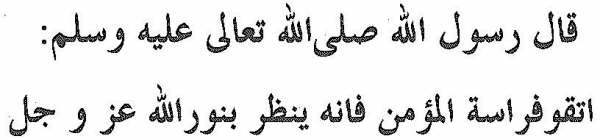
Meaning of the Hadith: Beware the Believer’s insight (firasat). Because he looks with the Light (Nur) of ALLAH (Azza wa Jalla).
So Allahu Dhuljalâl gave a light (Nur) into the heart of the True believer (mumin). By means of that light, by “firasat” and “kashfiyat”, beyond the “ikhlas” has been the state of salvation. Esoteric Knowledge (Ilmu’l-Batin) is like that. It is a “Ladunni” Knowledge. That is their assertion. These are regarded to be from the section of masters (saadat/efendi) within the nation of Muhammad s.a.w.s.
They are not like the Zahiri Alims (Exoteric scholars).
Their hearts are empty from ‘anything other than ALLAH (Masiwa)’. They don’t transmit anything other than ALLAH to their hearts.
Their hearts are not like a bin yard but entirely allocated to ALLAHU DHULJALAL.
Yes , no matter how much they seem to be working, doing work etc. their hearts are closed to “Masiwa”.
They are closed to anything other than ALLAHU DHULJALAL.
Their souls/selves (nafses) are free of “I –ness: ego (ananiyat)” and are pure and clean.
Their spirits (ruhs) are pure and very beautiful.
As to their secrets (sirrs), they are chaste/pure (nazih) and also luminous (nurani).
Now the knowledge (ilms) of such “Arifs” is permanent/everlasting (bakî).
The knowledge they possess is permanent within themselves.
They possess the Hâl (Spiritual State and Power).
As a matter of fact, every one is gathered (raised) based on the spiritual state he is in.
Whatever spiritual state (hâl) he is committing here, that “hâl” will be with him there as well.
They haven’t received this knowledge (ilm) from the dead people but they got it from the real alive people whose hearts have found life.
Does a heart, which is connected to Allahu Dhuljalâl and full of Divine Light, ever die?
That is why the hearts of such people are alive (hayy).
The knowledge (ilm) they receive and transmit is also alive and does not die. The noble verse related to this knowledge is as below:
وَعَلَّمْنَاهُ مِن لَّدُنَّا عِلْمًا
“…..Wa `Allamnāhu Min Ladunnā `Ilmāan”
“….and We had taught him knowledge from Our presence” [ Qur’an, Al-Kahf, (18/65) ]
Now “sahih (genuine) [3]” men/women of the heart is as this.
To be able to be the owner of the secret (sirr) and discover (making kashf) the secrets…
In fact, “futuhat [4]” starts together with the secret (sirr). They are both together…
If the secret (sirr) and “futuhat” are together, then everything goes right.
If the “futuhat” comes before the secret (Sirr), he runs in to danger.
If the both are together then they become marvellous persons.
[3] Sahih (Arabic word): 1.genuine, authentic, sincere, pure, doubtless, spotless, 2. An act of worship (ibadat) whose conditions and “rukuns” were fulfilled and complete.
[4] Futuhat (Arabic word): Opening, conquering, victories.

Meaning of the hadith: Janab-i Rasulullah (Sallallahu Alaihi wa Sallam) is stating that whoever wakes up with sincerity (ikhlas) for 40 days (without any envy (hasad), malice (fasad), enmity etc.) as being pure and in private with his Lord. Whoever wakes up not being with the people but with his Creator in private for 40 days…
Again from Anas Ibn-I Malik and some sahabas said: whoever revives one of my sunna without any grudge (hasad or fasad) in his heart against anyone in the morning and evening for forty days, he becomes together with me on the qiyamat (day of resurrection) and my intercession (shafaat) becomes wajib for him.
Note: A version of the hadiths mentioned above is mentioned in Tirmizi as following:
Anas ibn Malik said, “The Messenger of Allah said to me, ‘My son, if you can be without any grudge in your heart against anyone in the morning and evening, be like that.’ Then he added, ‘My son, that is part of my Sunna. Whoever gives life to my sunna has loved me and whoever loves me is with me in the Garden.'” (at-Tirmidhi)
In fact, Rasulullah (Sallallahu Alaihi wa Sallam) is a “bashar [5] ” being the grace to the worlds (Rahmatanlil Alameen). He is a “bashar” but the purest (nazih) one.
When we say stone, a ruby is a stone, and marble is also a stone. Are they both equal, just because they were both called stones? Just because their names have been stones?..
Now the “kâmil firasat” is this.
Those who are the people of “firasat” will understand…
[5] Bashar: (arabic word). Sons of Adam. General name used for the sons of Adam. The statement “sons of Adam” includes all mankind not only ‘Able (Khabil)’ and ‘Cain (Kabil)’.
Alaaddin-i Attar (k.s):
When you get near the people who are ahl-i sidq (Truthful People. Those who are truthful and loyal to their oath.), if he possesses the “firasat”, beware and let your intention be “halishane: sincere/clean/genuine”.
Because those kinds of people enter in to the hearts and investigate, and they can not be deceived.
They are the spies of the hearts.
There is no “closed/covered” for them.
The people of “firasat” are these.
They are the ones who do not have any mistake (falsity) and they find the mistake (false) right at that moment.
That is why, in a noble “hadith” narrated by Abu Ayyubu’l-Ansari (r.a), Rasulullah (Sallallahu Alaihi wa Sallam) is saying:
“whoever wakes up for forty mornings by being tied to Allahu Dhuljalal with purity and sincerity (ikhlas) (without having masiwa, hasad, fasad and enmity etc. in his heart), wisdom (hikmats) would spring forth from his heart to his tounge.”
Note: Various versions of the above mentioned hadith are quoted in Islamic resources. e.g.
“Whoever wholly dedicates to Allah forty days, the wellsprings of wisdom shall appear from his heart to his tongue.”
Narrated by Ibn Abi Shayba (7:80), al-Quda`i in Musnad al-Shihab (1:285), Ahmad, Hannad, and Ibn al-Mubarak, all three in their Zuhd, al-Daylami in Musnad al-Firdaws (3:564), Abu Nu`aym in the Hilya (5:189, 10:70) and others through so many chains both from Companions – Ibn `Abbas, Abu Ayyub al-Ansari, Abu Musa al-Ash`ari, `Ali, Abu Dharr, and Anas – and mursal – from Makhul and Safwan ibn Sulaym – that it reaches the grade of hasan sahih according to Shaykh Ahmad al-Ghumari in al-Mudawi li-`Ilal al-Jami` al-Saghir wa-Sharhay al-Munawi (6:108-111).
Ibn Taymiyyah said:
حكي أن أبا حامد الغزالي بلغه أن من أخلص لله أربعين يوما تفجرت ينابيع الحكمة من قلبه على لسانه
قال: فأخلصت أربعين يوما فلم يتفجر شيء فذكرت ذلك لبعض العارفين فقال لي: إنك إنما أخلصت للحكمة ولم تخلص لله تعالى
”… News reached Abu Hamid al-Ghazali that whoever proves sincere to Allah for forty days, wisdom springs from his heart and is established upon his tongue.”
Again in the Awarif al ma`arif printed on the margins of Ihya’ al ‘ulum, vol. 2, p. 256, it is mentioned:
A statement of the Messenger of Allah: `Whoever dedicates [himself] to God for forty days, God makes springs of wisdom flow from his heart on his tongue.’
Abu Bakr Shibli is saying that:

”Whoever inclines to the world and gets attached to it, then he is burned by the fire (Nâr) of the world and comes to the state of a “ramad (parched, burning ash)”, and becomes ash. As for ash, if a wind blows, it is scattered in grains, and not even a trace of it remains.
Whoever inclines towards the hereafter (akhirat) and tends towards the matters related to the hereafter by love and enthusiasm, then the light (Nur) of the hereafter burns him and he becomes pure gold. And this inclination of him brings a red gold that will give him the benefit…What brings him to the state of gold is not fire (Nâr) but light (Nur). And whoever tends only but only towards ALLAHU DHUL JALÂL by being in the state of emptiness from both the world and the hereafter, and makes this choice, then (ALLAH) burns that person with the light of Oneness/Unity (Nur-u Tawhid), and when this happens, that person becomes a priceless gem (jawhar).”
Imam-i Nawawi says: They divorced the world in 3 “TALAQs (3 times divorcing. Talaq means, to divorce, to leave, to untie a knot)” and their return was not possible anymore.
Especially when the aim which they fall in love with is to attract the “MuHaBBat” of ALLAHU DHUL JALAL, and when they become successful in this, they get burned by the Light of Oneness/Unity (NuR-u Tawhid). When they are alit by the love of “Muhabbatullah”, then they become a priceless gem whose worth can not be appraised.
In the sight of Allah, they become “Aziz” and “Muazziz”..
And that is a big honour (sharaf).
Allahu Dhuljalal is stating in this “ayat-i jalila”:
وَالَّذينَ جَاهَدُوا فينَا لَنَهْدِيَنَّهُمْ سُبُلَنَا وَاِنَّ اللّٰهَ لَمَعَ الْمُحْسِنينَ
Wa Al-Ladhīna Jāhadū Fīnā Lanahdiyannahum ۚ Subulanā Wa ‘Inna Al-Laha Lama`a Al-Muĥsinīna :
And those who strive in Our (Cause), We will certainly guide them to Our Paths for verily Allah is with those who are “Muhsin [6]”. [ Qur’an, Al-Ankabut, (29/69) ]
[6] Muhsin: It is an Arabic word meaning beneficial, generous, those who do right, those who do favours and behave kindly, and those who do most beautifully whatever they do. Muhsin means the person who worships Allah as if he sees Him. Those who perform “ihsan”. They do good deeds beautifully and sincerely for the sake of Allah. They are intrinsic and sincere in their acts.
This means, to those who strive (makes Jahd-u-juhud) in our path, and to those who strive in the path of Allahu Dhuljalâl and resort seriously and sincerely to Our path, we show our path to them as very easy.
If he continues within this way, let him know that Allahu Dhuljalal loves the people of “Ihsan (beneficience) [7]”.
Because , those are the people of “Ihsan”.
As to this, this is a big honour.
[7] Ihsan (Arabic: إحسان): also spelled as Ehsan, is an Arabic term meaning “perfection” or “excellence (Ara. husn). It is a matter of taking one’s inner faith (iman) and showing it in both deed and action, a sense of social responsibility borne from religious convictions.[1] In Islam, ihsan is the Muslim responsibility to obtain perfection, or excellence, in worship, such that Muslims try to worship God (Arabic Allah) as if they see Him, and although they cannot see Him (due to the belief that Allah is not made of materials), they undoubtedly believe that He is constantly watching over them. That definition comes from the Hadith of Gabriel in which Muhammad s.a.w.s states, “[Ihsan is] to worship God as though you see Him, and if you cannot see Him, then indeed He sees you.” (Al-Bukhari and Al-Muslim).[2]

يَا أَيُّهَا الَّذِينَ آمَنُوا اسْتَعِينُوا بِالصَّبْرِ وَالصَّلاَةِ إِنَّ اللّهَ مَعَ الصَّابِرِينَ
“Yā ‘Ayyuhā Al-Ladhīna ‘Āmanū Asta`īnū Biş-Şabri Wa Aş-Şalāati ۚ ‘Inna Al-Laha Ma`a Aş-Şābirīna:
O ye who believe! seek help with patient perseverance and prayer: for Allah is with those who patiently persevere.” [ Qur’an, al-Baqara, (2/153) ]
In other words, o people of faith (ahl-i iman)! Firstly, be the ones who possess patience. Do the prayer (salah) in most beautiful manner, and do not be in haste, and be patient. Allahu Dhuljalâl is with those who patiently persevere.
Because patience (sabr) is the one half of faith (iman).
The other half of it is “shukr : gratitude [8] ”.
Man is a “bashar” in the end.
Illness can befall him, poverty can befall him. When a tribulation befall him such as these financially or physically, he must certainly know how to be patient.
[8] ‘Shukur’ or ‘shukr’ is the expression of the thankfulness, gratitude and bashfullness towards the favour, boon and generosity of the Lord (nimat and ikram-i Rabbaniyya). In the expression of shukr, the wish of the repeating, continuity and increase of the favour is hidden.
Whose side is it coming from?
It is coming from Allahu Dhuljalâl!..
Are you going to object to Allahu Dhuljalâl?..
If this is from Him, then it is necessary to be patient without boiling over with rage.
There is a saying of Hadrat-i Omar (r.a). If an incident befalls someone, he is saying the following by showing himself as an example:
“I immediately think who is this coming from? It has come from ALLAH…In this case, are you going to withstand against Him? No…I also think that, if it is beneficial for me in this world or for my hereafter? To my hereafter. Ooh how nice it is, if it is beneficial for my hereafter (akhirat)…And again I also think that if it is extreme or in the state that I can tolerate? No (not extreme), it is in a state that I can bear …Haa, in that case, let it be!..”
Now you see, Hd.Omar (r.a)’s assertion was in these three situations.
“If it has come from ALLAH, it is possible to bear and show patience, and it is beneficial for your hereafter (akhirat) , then there is no problem…” he used to say.
Now that is the patience!..
Patience to the tribulations is this.
And of course, gratitude (shukur) for a favour (ni’mat) is also necessary.
If Allahu Dhuljalâl gave it, it is to show gratitude and make “shukur” by thinking about the poor instead of hoarding (the wealth) and acting roughly…
Allahu Dhuljalâl is doing an audit.
Surely, there will be both rich and poor , as they are both a necessity. Otherwise, who will you give “zakat” to?
This is a period of testing.
Otherwise, is Allahu Dhuljalâl’s budget not enough? If He wished, He could have made them all rich as Qarun…
But this world is the period of testing.
There is a censor of testing financially, physically and by our states and we are in it “Al-AN” (in every moment)…
إِنَّ اللّهَ يُحِبُّ الْمُتَوَكِّلِينَ
“……’Inna Al-Laha Yuĥibbu Al-Mutawakkilīna:
……..Lo! Allah loveth those who put their trust (in Him).”
[ Qur’an, Al’I –Imran, (3/159) ]
Allahu Dhuljalal loves those who put their trust in ALLAH (make tawakkul).
Because, who is “tawakkul” made to?
It is made to Allahu Dhuljalal…
Allahu Dhuljalal has power over all things (Kulli shayin Qadir). He is the power of the absolute (qudrat-i mutlak).
If the belief of “If something will come and happen, it comes from Him” is complete…
I am always giving an example.
Why are the government officials not saying, “I wonder if they could give me my salary”?
When he reaches to the payday, he is regarding it as if it (payment) is overcome or guaranteed.
He is not hesitating or saying “what if they forget to pay?”.
Our blessed (mubaraq) Sheikh used to say: “Officers are
weak in their trust (tawakkul).
This means they are not worried.
So, why are we not the people of “Tawakkul” towards the Creator (Al-Haliq) and Sustainer (Ar-Razzaq) of the Universe, Allahu Dhuljalal?
Once upon a time, a darwish was sitting in a cell.
As the Imam was always seeing him sitting like this, he asked him:
“What are you doing, you keep sitting over here?”
When the darwish answered by saying “I sat down and I am remembering (doing dhikr)”,
The Imam: “who is providing your sustenance (rizq) then? Go and work!.”
When this incident repeated a few times, when the imam asked again another day, the darwish answered: “You see, that Jewish neighbour stood security for me to give a daily bread (he guaranteed to give a daily bread for me).”
The imam said: “In that case, sit down and make dhikr (remember Allah).”
Upon hearing this, the darwish said:
“Now, you can not stand for prayer behind an imam like this. He esteemed the guaranty of the Jewish neighbour but he ignored (disregarded) the guaranty of Allahu Dhuljalal.”
وَاللّٰهُ وَلِىُّ الْمُتَّقينَ
”….. Allāhu Wa Līyu Al-Muttaqīna “
”….Allah is the “wali”(friend/guardian) of those who guard (against evil) ” [ Qur’an, Al-Jathiyah, (45/19) ]
Allahu Dhuljalal loves the “Muttaqi” ones. They don’t only guard themselves against impermissible (haram) but also guard against unsure things.
وَهُوَ يَتَوَلَّى الصَّالِحينَ
” …wa Huwa Yatawallá Aş-Şāliĥīna.”
“….and He befriends the righteous. “ [ Qur’an, Al-Araf, (7/196) ]
Allahu Dhuljalal is taking the ones who are Salihin (good, righteous) under His guardianship (walayat).
اِنَّ رَحْمَتَ اللّٰهِ قَريبٌ مِنَ الْمُحْسِنينَ
”….. ‘Inna Raĥmata Al-Lahi Qarībun Mina Al-Muĥsinīna.”
“….. Lo! the mercy of Allah is nigh unto the good (Muhsinin).”
[Qur’an, Al-Araf, (7/56) ]
The mercy (rahmat) of Allah towards the people of “Ihsan” is very close. Because He Himself is the One who makes “Ihsan”.
He is the Giver and Beautiful.
“Muhsin” is this.
(Please see the previous explanations of the terms, Muhsin and Ihsan respectively in word references [6] and [7])
وَاعْلَمُوا اَنَّ اللّٰهَ مَعَ الْمُتَّقينَ
”…Wa A`lamū ‘Anna Al-Laha Ma`a Al-Muttaqīna”
”…But know that Allah is with those who restrain themselves.” [Qur’an , Al-Tawba, (9/36) ]
Allah is with the “Muttaqi” [9] ones.
[9] Muttaqi: It is an Arabic term. The term “Taqwa”is hidden in this term. Muttaqi means the one who lives with “taqwa”. The one who guards/protects himself against the things which prevent him from reaching spiritual maturity/perfection (kamalat), corrupt the mind, heart and soul and divert his mind and heart from the remembrance of Allah. Muttaqi is to be strong (qawiy) and have endurance against the desires of the soul/self (nafs) for the sake of Allah. Muttaqi will avoid the sins and forbidden (haram) things which Allah and Rasul (saws) explained.
وَاَنَّ اللّٰهَ مَعَ الْمُؤْمِنينَ
”…. Wa ‘Anna Al-Laha Ma`a Al-Mu’uminīna”
”….for verily Allah is with those who believe!” [Qur’an, Al-Anfal, (8/19) ]
اِنَّ اللّٰهَ يُحِبُّ التَّوَّابينَ وَيُحِبُّ الْمُتَطَهِّرينَ
”….’Inna Al-Laha Yuĥibbu At-Tawwābīna Wa Yuĥibbu Al-Mutaţahhirīna”
“….For Allah loves those who turn to him constantly and he loves those who keep themselves pure and clean” [ Qur’an, Al-Baqara, (2/222) ]
Allah loves those who keep themselves clean from mistakes and blemishes and those who turn to Him in repentence (tawba).
اِنَّ اللّٰهَ يُدَافِعُ عَنِ الَّذينَ اٰمَنُوا
”İnnellahe yudafiu anillezine amenu…..”
”Verily Allah will defend those who believe…..”
[Qur’an, al-Hajj, (22/38) ]
Allah repels the torment and anguish from the believers, which are caused by the “Mushriks (those who associate a partner with God)”, and Allah does not put them down in to unpleasant states and conditions. Now these noble verses; are the explicit “nass” [10] and eloquent speeches.
[10] Nass: A word or a verse in the Qur’an or a hadith whose meaning is evident , clear and does not need a further commentary about a subject, a work or a case . “Aqida”.
Their knowledge is in the direction of Haqq (Truth) and it enables/makes these people to be “amileen”, “saliheen”, “haliseen”, “muhliseen”, “mumineen”, “mutawakkileen”, ”muttakeen”, “muhsineen”, “ajizeen”, “sabireen”, “hamideen”, “shakireen”, “mutafakkireen”, “dhakireen” in that direction.
amileen: Those who act and do good in accordance with their knowledge.
saliheen: Pious ones. People of Peace. Righteous ones. Fit and suitable.
haliseen: Pure and sincere ones. Pure from evil.
muhliseen: Those who are sincere in their acts and worship on the path of God. Those who have “ihlas”. They only do their acts for the sake of God and they also help the others to be pure and sincere on the path of God.
mumineen: Those who believe in God.
mutawakkileen: Those who put their trust in God.
muttaqeen: Those who guard themselves against evil and fear from the Haqq (Truth).
muhsineen: Those who are the doers of good.
ajeezeen: Those who know their inability near God, and require the guidance and help of God in their acts. Those who have unlimited requirements but limited strength. Those who have fear of Allah and do not use his power against the creation.
sabireen: Patient ones who have inner patience against difficulties on the path of the Truth.
hamideen: Those who praise (make hamd) God. Hamd is a very deep term which can not be explained by only “praising”.
shakireen: Those who have gratitude towards God.
mutafakkireen: Those who think, reflect, ponder and use their esoteric power (batini kuvvet) in thinking about the Creator and the creation.
zakireen: Those who remember God.
رِجَالٌ لَا تُلْهيهِمْ تِجَارَةٌ وَلَا بَيْعٌ عَنْ ذِكْرِ اللّٰهِ
”Rijālun Lā Tulhīhim Tijāratun Wa Lā Bay`un `An Dhikri Al-Lahi ….”
”By men whom neither traffic nor merchandise can divert from the Remembrance of Allah……” [ Qur’an, al-Nur, (24/37) ]
There are such people that neither trade nor merchandise can divert them from the Rememberance of Allah and occupy them. If it is looked at the appeareance of these people, they seem to be working, doing some work or occupied with some things amongst the public. But their hearts and minds are never diverting from their targets and they are remembering (dhikr) ALLAH. They are remembering Allahu Dhuljalâl in their hearts and the rememberence (dhikr) of ALLAH never remain silent in their hearts. There would be no outage/stoppage (in dhikr of Allah).
No matter how much he merchandises or he is amongst the people, he has surrendered his heart to his Lord (Rabb) and his body (form) is working amongst the people. But his heart is with Truth (Haqq).
اِنَّ الَّذينَ قَالُوا رَبُّنَا اللّٰهُ ثُمَّ اسْتَقَامُوا فَلَا خَوْفٌ عَلَيْهِمْ وَلَا هُمْ يَحْزَنُونَ
” ‘Inna Al-Ladhīna Qālū Rabbunā Al-Lahu Thumma Astaqāmū Falā Khawfun `Alayhim Wa Lā Hum Yaĥzanūna: Lo! those who say: Our Lord is Allah, and thereafter walk aright, there shall no fear come upon them neither shall they grieve.” [ Qur’an, Al-‘Ahqâf, (46/13) ]
However, when it comes to the scholars who act contrarily to their words or their acts are contrary to their states (hâl), Allahu Azza wa Jalla says :
اَتَاْمُرُونَ النَّاسَ بِالْبِرِّ وَتَنْسَوْنَ اَنْفُسَكُمْ وَاَنْتُمْ تَتْلُونَ الْكِتَابَ اَفَلَا تَعْقِلُونَ
‘Ata’murūna An-Nāsa Bil-Birri Wa Tansawna ‘Anfusakum Wa ‘Antum Tatlūna Al-Kitāba ۚ ‘Afalā Ta`qilūna: Enjoin ye righteousness upon mankind while ye yourselves forget (to practise it)? And ye are readers of the Scripture! Have ye then no sense? [Qur’an, Al-Baqara, (2/44) ]
يَا اَيُّهَا الَّذينَ اَمَنُوا لِمَ تَقُولُونَ مَا لَا تَفْعَلُون۞كَبُرَ مَقْتًا عِنْدَ اللّٰهِ اَنْ تَقُولُوا مَا لَا تَفْعَلُونَ
Yā ‘Ayyuhā Al-Ladhīna ‘Āamanū Lima Taqūlūna Mā Lā Taf`alūna ۞ Kabura Maqtāan `Inda Al-Lahi ‘An Taqūlū Mā Lā Taf`alūna. :
O ye who believe! Why say ye that which ye do not? Grievously odious is it in the sight of Allah that ye say that which ye do not. [Qur’an, Al-Saff, (63/2-3) ]
لَا تَحْسَبَنَّ الَّذينَ يَفْرَحُونَ بِمَا اَتَوْا وَيُحِبُّونَ اَنْ يُحْمَدُوا بِمَا لَمْ يَفْعَلُوا فَلَا تَحْسَبَنَّهُمْ بِمَفَازَةٍ مِنَ الْعَذَابِ وَلَهُمْ عَذَابٌ اَليمٌ
Lā Taĥsabanna Al-Ladhīna Yafraĥūna Bimā ‘Ataw Wa Yuĥibbūna ‘An Yuĥmadū Bimā Lam Yaf`alū Falā Taĥsabannahum Bimafāzatin Mina Al-`Adhābi ۖ Wa Lahum `Adhābun ‘Alīmun :
Think not that those who exult in what they have brought about, and love to be praised for what they have not done, think not that they can escape the penalty. For them is a penalty grievous indeed. [Qur’an, Al’I-Imran, (3/188) ]
Now even these verses are clear and evident eloquent speeches about the states of such scholars. Such scholars order the good as if they themselves are the people of salvation (saha), “wafa [11]”, “zuhd [12]” and “contentment (qanaat)”.
And they forbid the rebellion (masiyat), vileness (dhillat), envy (hasad), holding a grudge and taking revenge, treachery-enmity and deception (gıll-ü-gış), betrayal of trust, meanness, ambition, greed and avarice.
[11] Wafa: Wafa means to be loyal to his word and oath, to be loyal and connected to someone with love.
[12] Zuhd: “Az-Zuhd, in the Arabic language, the language of Islam, entails abandoning a matter while despising it and while belittling its significance, so that one will exchange it for what is more significant.”
Ibn Al-Qayyim said, “I heard Shaikh Al-Islam ibn Taymiyyah say, ‘Az-Zuhd entails abandoning what does not bring about benefit in the Hereafter. Al-Wara’ (abandoning a part of the permissible for fear of falling into the impermissible) entails abandoning what you fear its consequences in the Hereafter.” There are many verses in the Qur’an related to “zuhd”.
However, they themselves live by totally turning towards and are attached to the creation with the love of the world, with the desire of gaining status, with the lust (shahwat) and “haram (forbidden things)”.
They are in doubt about Allah.
But they put their trust in the things which will come to them from things that are other than Allah (masiwa).
However, Allahu Dhuljalal says in the verse below:
قُلْ بِفَضْلِ اللّٰهِ وَبِرَحْمَتِه فَبِذٰلِكَ فَلْيَفْرَحُوا هُوَ خَيْرٌ مِمَّا يَجْمَعُونَ
“Qul Bifađli Al-Lahi Wa Biraĥmatihi Fabidhālika Falyafraĥū Huwa Khayrun Mimmā Yajma`ūna Say:
In the bounty of Allah and in His mercy: therein let them rejoice. It is better than what they hoard.” [Qur’an, Al-Yunus, (10/58) ]
Allahu Dhuljalal is commanding His beloved (Habib) s.a.w.s : Say: the fadlu kareem of Allah is better than what they gather from people.
Allahu Dhuljalal qualified the scholars, and distinguished and stated the differences between them clearly and evidently in some noble verses. But we are going to remember just a little portion of them here:
قُلْ هَلْ يَسْتَوِى الَّذٖينَ يَعْلَمُونَ وَالَّذٖينَ لَا يَعْلَمُونَ اِنَّمَا يَتَذَكَّرُ اُولُوا الْاَلْبَابِ
”…….Qul Hal Yastawī Al-Ladhīna Ya`lamūna Wa Al-Ladhīna Lā Ya`lamūna ۗ ‘Innamā Yatadhakkaru ‘Ūlū Al-‘Albābi : …..Say: are those equal, those who know and those who do not know? It is those who are endued with understanding (‘Ūlū Al-‘Albāb) that receive admonition.” [Qur’an, Az-Zumar, (39/9) ]
Are those who know and those who don’t know Allahu Dhuljalal equal? Only “’Ūlū Al-‘Albāb (People of the Essence)” will understand/comprehend.
يُؤْتِى الْحِكْمَةَ مَنْ يَشَاءُ وَمَنْ يُؤْتَ الْحِكْمَةَ فَقَدْ اُوتِىَ خَيْرًا كَثيرًا وَمَا يَذَّكَّرُ اِلَّا اُولُوا الْاَلْبَابِ
”Yu’utī Al-Ĥikmata Man Yashā’u ۚ Wa Man Yu’uta Al-Ĥikmata Faqad ‘Ūtiya Khayrāan Kathīrāan ۗ Wa Mā Yadhdhakkaru ‘Illā ‘Ūlū Al-‘Albābi :
He giveth wisdom unto whom He will, and he unto whom wisdom is given, he truly hath received abundant good. But none remember except men of understanding.” [Qur’an, Al-Baqara, (2/269) ]
Source: Muhammed Siddik Hekim Efendi (k.s), Mursitlerin Halleri, Zahiri ve Batini Alimler.
Translated from Turkish to English by garibAN
English Grammar Check: Colleen M.Dunn
Released on the internet on 14.11.2011 in Basildon-UK
www.muhammedinur.com