The Canadian Muslim Girl’s Story

"Islam"
The Canadian Muslim Girl’s Story

Then, since the object of desire exists not in anyplace, how canst thou purpose to journey towards Him on foot? The highroad by which thy spirit and prayers can travel towards God lies in the polishing of the mirror of the heart. The mirror of the heart becomes not free from the rust of infidelity and hypocrisy by opposition and hostility; the burnisher of the mirror is your steadfast faith; again, what is it? It is the unsullied purity of your religion. To him in Continue reading “ON PURITY OF HEART”
Continue reading “FORGIVENESS – THE WISDOM (IRFAN) OF BAWA MUHAIYADDEEN”


Merits of the Month of Ramadan
Believers, fasting is ordained for you — as it was ordained for those before you, so that you may practice self-restraint — for a certain number of days; and for those among you who are sick or on a journey, a number of other days, while incumbent upon those who can afford it is expiation by feeding a needy person. To do good willingly is better for one, and to fast is better for you if you did but know. [2:183-184]

The Sheikh says: My son, fasting is observed in many ways in the various religions and languages. Human beings fast for different lengths of time and for different reasons. But we must reflect on this with wisdom.
Like the Sand
Like the Candle
Love made of Snow
Like my Hope Continue reading “ZAWK 4346 – SANDMAN and SNOWMAN”
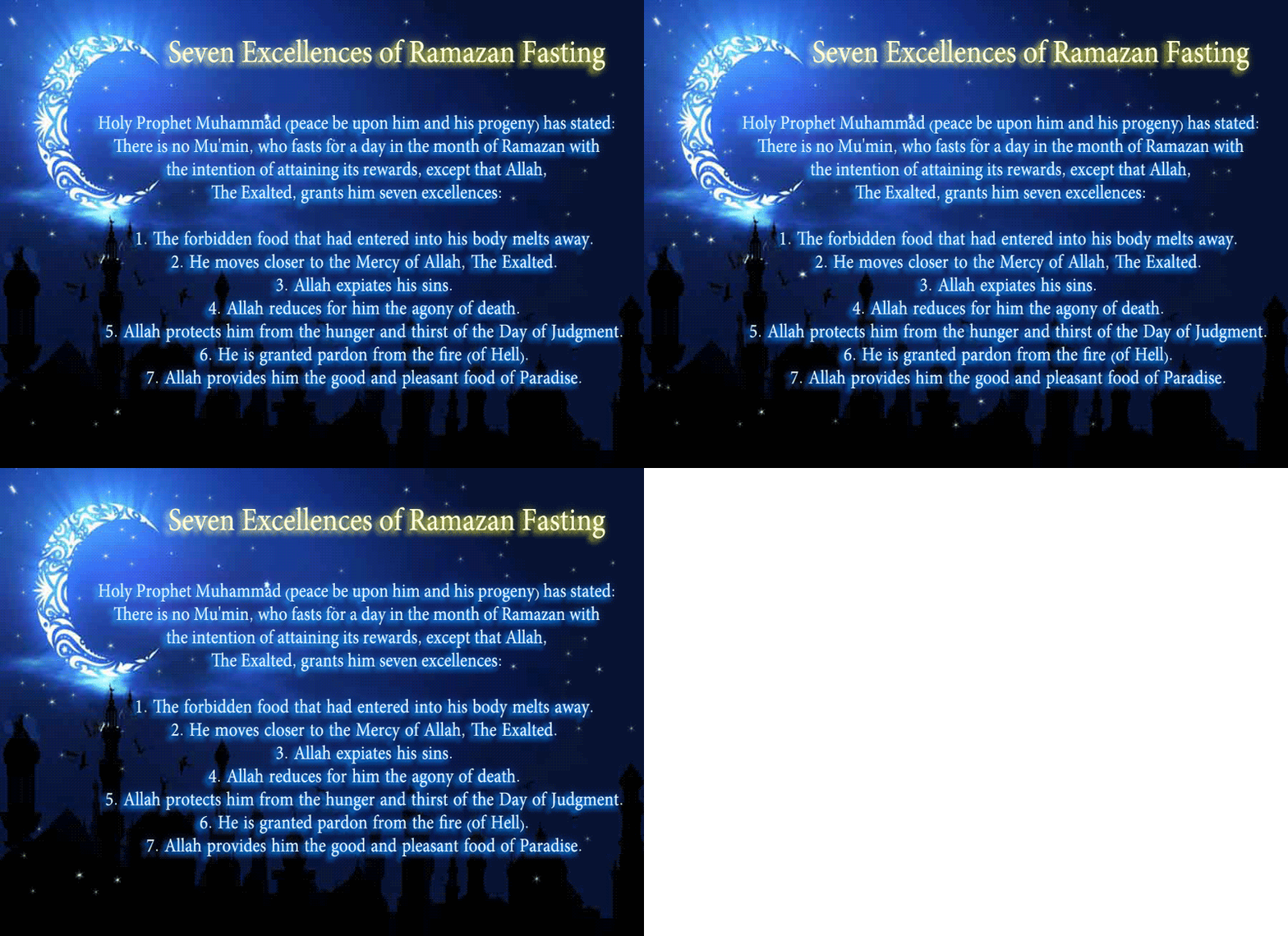
Ramadan and Fasting According to
Hz. Mevlânâ
A study of the Mathnawí and Divan-i Kebîr of Hz. Mevlânâ reveals to us the opinions of Hz. Mevlânâ regarding the month of Ramadan and fasting:
“The passion towards fasting is very unique” says Hz. Mevlânâ. He mentions how much he misses fasting and how strong he feels the absence of fasting. Sometimes he regards fasting as a “Mother”.
Ramadan, the month of fasting, should be welcomed with joy and we should be thankful and appreciative to Allah.
Fasting reveals the faith of a person, the love towards Allah, the devotion to Allah, the forbearance for Allah’s sake, the abstention from the things forbidden by Allah.
During the month of Ramadan, it is necessary to abstain not only from eating and drinking, but also from speaking bad words or doing bad deeds…we have to exercise patience against bad things.
It is not easy to fast but it helps you to develop an aptitude for many difficulties. Fasting makes the ego (nefs) and Shaitan (The devil) feeble and frail, purifies the physical and spiritual body, frees gönül (the spiritual heart) from worldly affairs, sets the soul free, sharpens the spiritual eye, teaches patience, teaches ways to escape illnesses, matures people, increases spiritual food, makes people become closer to Allah. Continue reading “Ramadan and Fasting According to Hz. Mevlânâ (k.s.)”

Taqwa: Between Love & Fear
Translating Love Into Good Deeds
Various verses in the Qur’an explain the characteristics that a person should have in order to receive God’s love. One of those traits is taqwa or God-consciousness, which is referred to in the Qur’an:[For lo! Allah loveth those who ward off (evil)](Aal `Imran 3:76).
God also loves those who have trust in Him.
Also, people who constantly repent to God deserve His love:[For Allah loves those who turn to Him constantly and He loves those who keep themselves pure and clean] (Al-Baqarah 2:222), which means that the door for repentance is open if a person sins, and not only does God accept those who repent, but He also loves them. Continue reading “Taqwa: Between Love & Fear II”

Musab Ibn Umayr (r.a.)
Musab ibn Umayr was born and grew up in the lap of affluence and luxury. His rich parents lavished a great deal of care and attention on him. He wore the most expensive clothes and the most stylish shoes of his time. Yemeni shoes were then considered to be very elegant and it was his privilege to have the very best of these. As a youth he was admired by the Quraysh not only for his good looks and style but for his intelligence. His elegant bearing and keen mind endeared him to the Makkan nobility among whom he moved with ease. Although still young, he had the privilege of attending Quraysh meetings and gatherings. He was thus in a position to know the issues which concerned the Makkans and what their attitudes and strategies were. Among Makkans there was a sudden outburst of excitement and concern as Muhammad, known as al-Amin (the Trustworthy), emerged saying that God had sent him as a bearer of good tidings and as a warner. Continue reading “Musab Ibn Umayr (r.a.)”